
Budapest Gallery
1036 Budapest, Lajos utca 158.
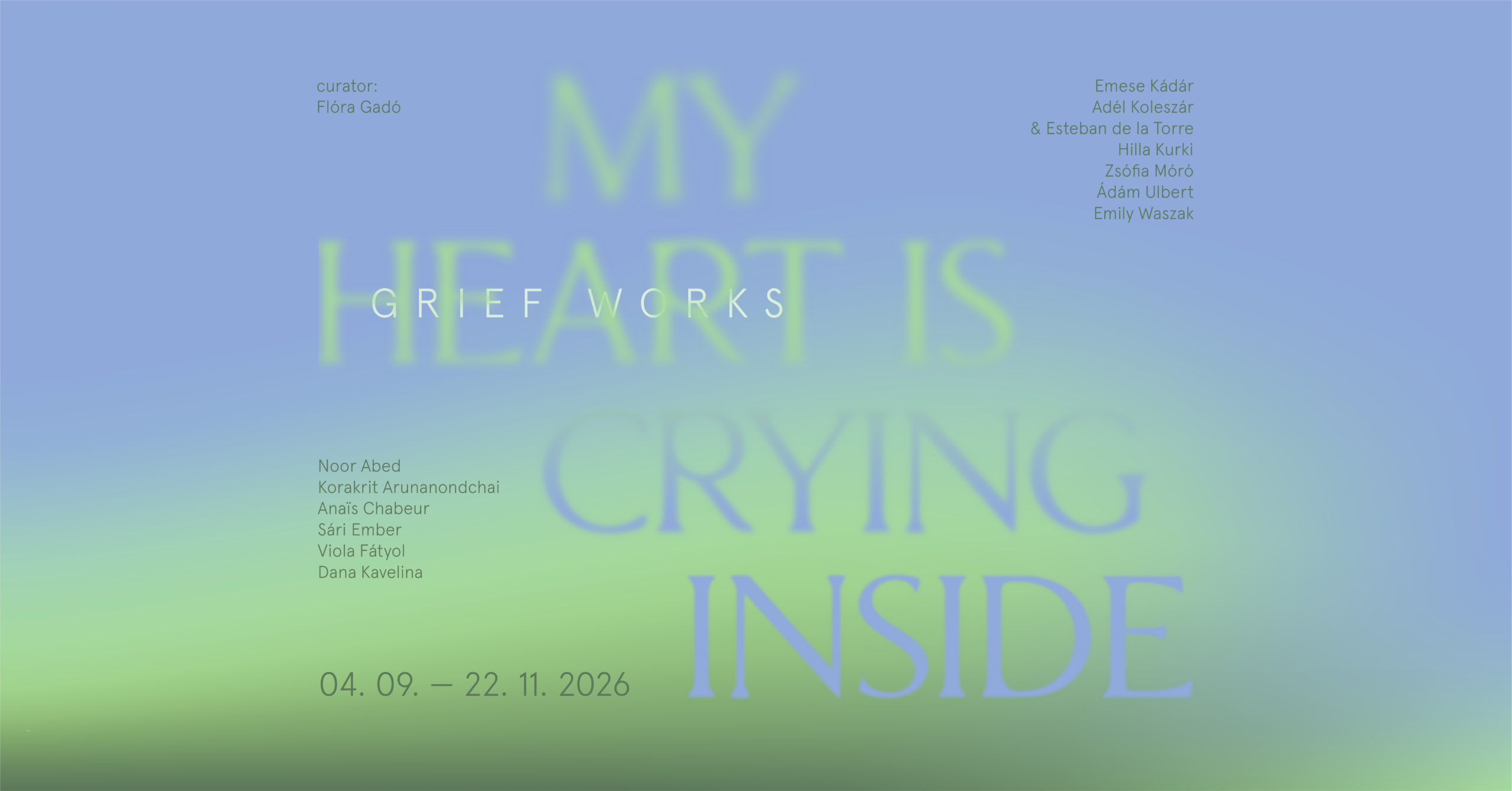
4 September – 22 November 2026
Exhibiting artists:
Noor Abed, Korakrit Arunanondchai, Anaïs Chabeur, Sári Ember, Viola Fátyol, Dana Kavelina, Emese Kádár, Adél Koleszár and Esteban de la Torre, Hilla Kurki, Zsófia Móró, Ádám Ulbert, Emily Waszak
Curator:
Flóra Gadó
Assistant Curator:
Fanni Tóth
Coordination:
Dalma Eszter Kollár, Lujza Anna Szász
Vernissage:
3 September 2026 (Thursday), 6:00 pm
Opening performance:
Korom Sasu and Júlia Vavra
Graphic design:
Réka Imre
Translation:
Dániel Sipos
Communication:
Zsuzsa Gámán
Art education:
Ágnes Szabics
Installation:
Péter Gyenei, László Hatházi, Zsigmond Peternák
Supported by:
General Representation of Flanders
The exhibition focuses on the concept of grief: our personal relationship to it, its social and societal dimensions, and the transformation of customs associated with demise. In late capitalist society, death is increasingly represented less as a part of life and much more as something isolated and detached from it; like the conditions of illness and ageing, it has gradually become medicalised and turned into an increasingly impersonal process. Just as our rites of passage have changed or even disappeared altogether, so is the final stage of our lives increasingly spent in hospitals, in solitude, without a supportive environment or a space that can hold us. In this social order, not only death but also the associated mourning process has become almost taboo: when we grieve, we are less productive and thus less useful members of society. By placing the emphasis on a comprehensive understanding of the phenomenon of grief, on persistent grief work and on supportive communities and connections, the exhibition challenges the taboo surrounding grief, the externally imposed expectations and the very act of making grief invisible.
My Heart Is Crying Inside – Grief Works presents, on the one hand, artistic positions in which the process of care extends not only to the living but also to those in the process of leaving this life. They conceive of care for the living and the dead as a reciprocal relationship in which one cannot exist without the other. They explore the transition from existence to non-existence and those who appear along this path as supporters and helpers. On the other hand, the works examine different modalities of grief: from personal losses through coping mechanisms to rites reconceived and recreated through various communal and collective processes of grieving. Some works extend the concept of grief to genocides and the incomprehensible tragedies of our time; to situations in which grief work encounters obstacles or even becomes impossible. Several artists reflect on the changing function of religion, the contemporary significance of spiritualism, and the transformation of rites associated with loss; the exhibition thus also raises the question of what lies on ‘the other side’ and how we can connect with our ancestors and our lost loved ones.
A common trait in the exhibited works is that instead of regarding the grieving process as a finite process or a period that can be brought to a close, they treat it as a phenomenon whose chaotic and transformative nature we must learn to live with. The loss of a loved one, the severing of a relationship, the casualties of war, or the victims of global disasters are all manifold and painful facets of grief, for which support can be found in overwriting taboos and expectations, talking openly, and communities offering care.
The title of the exhibition was borrowed from an interview with Zsuzsanna Kálló featured in Zsófia Móró’s work Blessed Are Those Who Mourn.